A result is not a diagnosis
Take a photograph of a mark on your skin. Upload it. Wait a few seconds. A result appears: “Low risk.” “High risk.” Perhaps even the name of a condition.
The experience can feel remarkably authoritative. An image goes in, an algorithm analyses it, and an answer comes back. But there is an important difference between an algorithm producing a result and knowing what a skin finding actually is.
Artificial intelligence has real potential in dermatology. Systems are being developed to help clinicians classify images and support defined clinical pathways. That is different from relying on a consumer app, a smartphone photograph and an automated result to decide whether something on your skin is harmless.
The distinction matters.
“AI skin scanner” is not one standard
Apps described as skin scanners can do very different things. Some help people photograph and monitor their skin. Some provide access to a healthcare professional. Some estimate whether a lesion appears suspicious. Others suggest a condition from an image.
Their algorithms, training data, image requirements and clinical validation can differ. The words “AI powered” tell you little about how trustworthy a particular result is.
The EADV AI Task Force’s 2026 review included 420 dermatology apps from a 2024 search across 44 European countries, with an additional AI skin-cancer app search in June 2026. Only 20% linked to peer-reviewed publications; 2% reported CE marking and 10% reported GDPR compliance.
These are reporting figures, not a compliance audit. Nor did every app have a diagnostic purpose. The practical point is narrower: app-store availability alone does not demonstrate that a diagnostic claim has been independently validated.
The photograph itself can change the result
Before an AI system can analyse a skin image, it needs a usable photograph. Lighting changes colour. Focus, distance and camera processing affect detail. Hair, shadows, reflections and difficult body locations can affect what the camera records.
In a 2026 independent prospective study of one app, 1,904 lesions were assessed. Capture failed for 16.6% under favourable conditions; user capture succeeded in 28.9% in a substudy. Performance also varied between phones.
The algorithm examines the image it receives. That image does not capture everything a clinical examination can establish.
Good performance still does not mean certainty
For successfully captured images in the same study, algorithm sensitivity was 82.5% and specificity 76.8%. Sensitivity is the proportion of cancers identified; specificity is the proportion of non-cancer findings correctly classified. These figures concern one app and study population, not all scanners or the chance that your result is correct.
A false positive can cause unnecessary worry. A false negative can create reassurance that delays professional assessment. A reassuring result should never be treated as proof that a skin finding is harmless.
An earlier BMJ systematic review (2020) also found variable performance and limitations in the available diagnostic studies. Its findings describe the apps and evidence assessed at that time; they are not a current rating of every app.
A dermatologist sees more than pixels
A photograph contains useful visual information. It does not contain the entire examination. A clinician can ask when something appeared, how it has changed, whether it bleeds, itches or hurts, and about relevant medical history. They can also examine the area and other skin findings.
A dermatologist may use dermoscopy, a magnified examination that reveals detail beyond an ordinary smartphone photograph. Depending on the finding, further tests may be needed.
Sometimes the important clue is not simply what something looks like today. It is what changed. An isolated image cannot automatically reconstruct that history. A photo history cannot replace an examination either.
AI performance may not be equal for everyone
An AI system learns from the data used to develop it. If certain skin tones, conditions or body locations are poorly represented, performance may not transfer equally to everyone who downloads the app.
A 2025 systematic review and meta-analysis reported lower performance in darker skin tones across the systems it examined. That does not mean every system performs poorly on darker skin. It means a headline such as “90% accurate” is not enough.
- Who was the system tested on, and which findings were included?
- Who took the photographs, and on which devices?
- Was performance tested independently?
- Does that evidence represent the person using it now?
Clinical AI and a consumer scanner are different
None of this means AI has no place in dermatology. It may become an important clinical tool. But its value depends on the particular system, its intended use and the pathway in which it is used.
The British Association of Dermatologists supports appropriately regulated and governed clinical AI, with clinically led evaluation and performance monitoring. Such oversight is different from a standalone consumer result.
The sensible position is not “Never use AI.” It is “Do not confuse AI assistance with medical certainty.”
Why Derma.Log takes a different approach
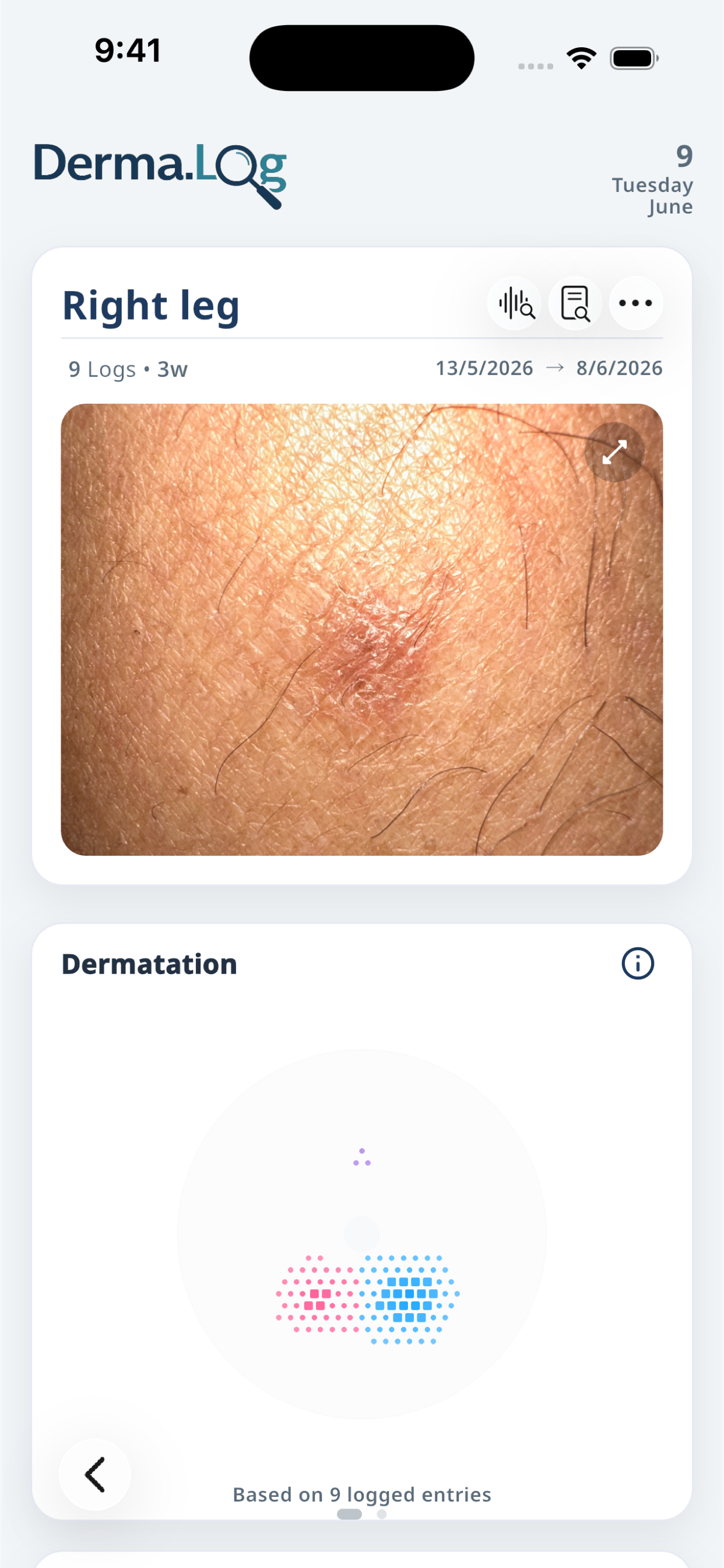
Derma.Log does not diagnose skin conditions or tell you that a skin finding is safe. It is an observation and record-keeping tool, built around preserving what you recorded.
A photograph records appearance at one point in time. A Log connects that photograph with the observation you made. Returning to the same Spot and adding later Logs creates chronology: a history you can revisit, review or export.
That history cannot diagnose a skin condition. It can keep information organized that might otherwise depend on memory or become lost among unrelated photographs.
The purpose is to preserve the record.
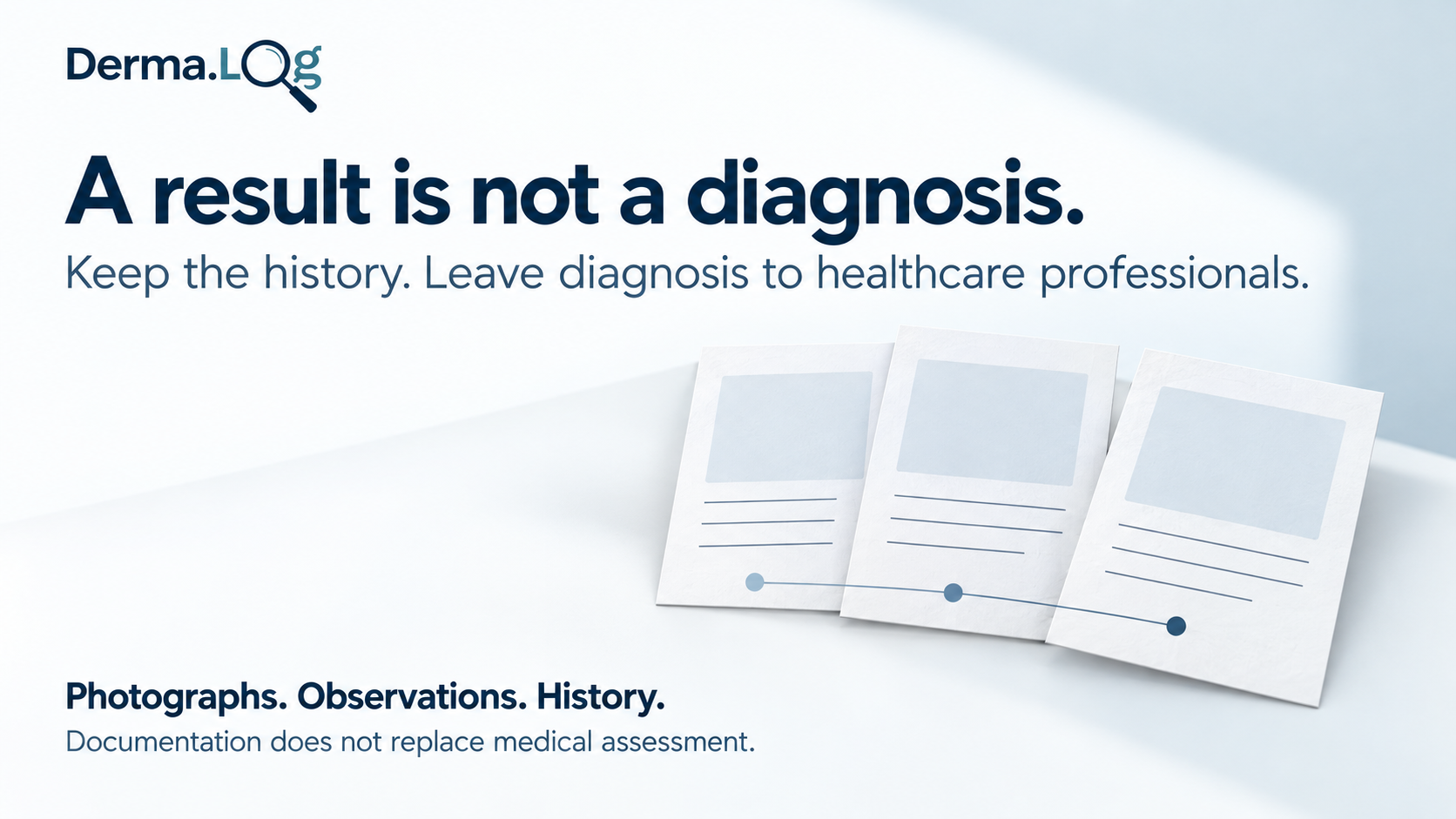
Keep the history. Leave diagnosis to healthcare professionals.
If a new, unusual or changing skin finding concerns you, seek professional assessment. Do not delay because an app returned a reassuring result, or while waiting to build a photo history. The American Academy of Dermatology’s guidance on health apps explains why an inaccurate app diagnosis can delay care.
Use technology to help you document. Use photographs to create a reference. Use history to remember what changed. When you need a diagnosis, ask someone qualified to make one.